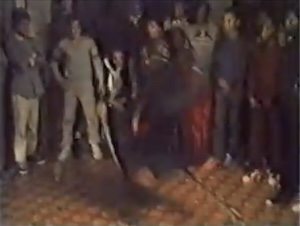
Battle, competitive breaking involving two or more dancers, almost always with music, and done in turns, called rounds, runs, or throwdowns. The preconditions for a battle are otherwise minimal—they may happen "anytime, anywhere." For Ken Swift, battles were "people trying to out skill each other using their personality, their body and the music" , which remains the modern understanding.1
The modern form of battling emerged in the mid-1970s, where breakers would take turns dancing in the cypher . Before this, Clark Kent related, "dancing was done simultaneously!!! That stuff that you see that one guy jumps in and one guy jumps out....that's later on. The art of dancing and burning somebody is to go against them simultaneously" . The appearance of battle within dance, already present in gang dances, burning, and rocking, was not only the consequence of aggressive and taunting gestures, but fulfilled social functions, which varied between individuals in different settings—as Schloss observed, "battles were very much integrated into the social world of their participants" . Additionally, Wallace D recalled, "a lot of them battles..it was contests. We used to win things... trophies, money, prestige, reputation" . This was not independent of the tradition of contest dancing that existed in the Bronx and Harlem, established over many decades prior to the 1970s.2 The music also played a role—Fab 5 Freddy called breaking "a macho thing where they would show each other who could do the best moves. They started going wild when the music got real funky" , summarized by Banes as "a physical analogue for a musical impulse" and Thompson as "improvising moves to match the new length and intensity of the music" . Yet Banes qualified, "breaking isn't just an urgent response to pulsating music" . DJ Smokey saw a connection between the music and the emerging "anger dance" , suggesting that the music facilitated the expression of frustrations precipitated by the wider context. Furthermore, going off to the music was not formally identical with battle, as a recollection by Caliph 09 illustrates:
Wallace D described battling Trixie, "every time we saw each other...and they played our songs...it was like, 'Come on, man! Let's go!!!' [...] It was kool, though. I enjoyed it" . Duesy related, "first you're dancing and a person starts– gets in front of you, because they want to show you– because they don't like the way you're moving, so they want to jump in there, and then you just go, 'Ohh, you want to do this!' And then that's where the battle came" . For Pow Wow, "I remember one night at Over The Dover... Ron tore that cat Little Barney a new asshole. That was a battle! A real B-Boy battle! That's what I call a B-Boy! Going to a party testing the waters. Like, 'Let me see what you got, motherfucker!' Jumping into the circle....showtime!" . Already in burning, dancers could battle for fun, as a game, though one's "reputation" was always involved. This is reflected in Trixie's simple assertion, "I had fun but I took it serious" . In a dramatic example, Sasa recalled of a battle, "really I didn't wanna go against him. Like my sister [...] called me on the phone and said, 'Get down here because he's calling you a chump, a chicken, you scared and everything.' Then they told me to get a cab, I got a cab came down there and then I just tore him and his brother up" . Reputation could be tied to the now-defamed ego, if the extent to which it is a product of social structures were recognized, as in its original idea, functioning as much as a tool for self-determination as for survival. Sasa described reputation, "like when you first come to High School you gotta adjust and you gotta find your way to fit in," adding later, "sometimes you had stick up kids there but when I popped up..the stick up kids were like, 'There goes Sasa!!' They wouldn't even try to rob me!" This notoriety harmonized with the DJs' intentions, as DJ Kool Herc considered battles "a part of the entertainment" ; Dancin Doug agreed, "we were the main attraction" . It might be noted that Herc sometimes showed films of boxing matches at his parties . Battle, if one does not take its resemblance to fighting as pure coincidence, necessarily contains a mimetic element. This is what Trac 2 described as "paying homage to what we grew up with, with the gangs and the rumbles" . Extending this, Alien Ness claimed, "you could take the b-boys back to the outlaw gangs of the late '60s, '70s. They were the original b-boys, and it was part of their war dances. That's why the competitive level is always going to be there with the b-boy. It's not just entertainment and flash; there is a competitive level, and that comes from its true essence and its roots" . This gets closer to the connection between breaking and gangs than the catchline "breaking replaced fighting." Yet Ken Swift and Yarrow Lutz observed, "breaking wasn't always competitive, but practitioners often wanted to demonstrate that their skills were better than those who came before them in the circle. As each dancer took turns trying to outperform another dancer and show off their individual variations of moves, the dance took on characteristics of a challenge and became known as a battle" . This is supported by Cholly Rock's assertion, "I wasn't coming with beef. I'm dancing. Because that's what it was with b-boys. You dance against cats that you think are good" , or Mike G's "you go after somebody who you feel that's going to give you a good battle" , and later with Crazy Legs:
In the mid-to-late 1970s, battles expanded from recreation rooms, parks, and clubs to sidewalks, hallways, and schools . As the setting of breaking shifted, it became more common to have crew battles, battles for opponents' shirts, battles for crew initiation, etc., reflecting another phase of gang influence. While small, spontaneous battles were the norm, the late 1970s also saw The Zulu Kings vs. The Shaka Zulus, the Battle at the Dungeon, and the Battle at St. Martin's. This form of large-scale crew battle remained relatively unchanged into the 1980s, as seen in the Floor Masters vs. Rock Steady Crew and Dynamic Rockers vs. Rock Steady Crew battles. Film disseminated this form worldwide. Ken and Lutz identified the important "buildup process" in these battles , touched on by Willie Will, who described, "first the whole crew would dance and then the best one from each crew would go down" . Later, in Germany, the influential Battle of the Year would establish the model for modern, tournament-style breaking contests. By the early 2000s, the interests of breakers and contest organizers, as well as the level of breaking, led to the establishment of large-scale one-on-one contests, reinforced especially by Red Bull BC One. Of particular consequence was the earlier Lords of the Floor, where, according to Jamieson Keegan, "Bob [the Balance] and I agreed together, let's build bleachers up off the floor so everyone's looking down at the action, because all the big b-boy contests in the world at that time were on a big stage. So you'd look up, so people would celebrate the big aerials, but no one would really see the amazing floorwork, so we're like, if we build it up, you can look down and get all the intricacies of those cool moves" .
Battle may be differentiated from cypher and performance , with implications for the dance's form. Ness even recommended "separating your runs into three categories: cypher moves, moves for the show and burners for the battles" . Historically, these contexts have been both fluid and overlapping, more closely resembling ideal types. Storm distinguished "confrontational dance challenges called Battles" from "dialogical dance circles called Cyphers" and from theatrical performances, though recognized that battles and cyphers "also serve as theatrical spaces" . Certainly, some rounds, in both battles and cyphers, are so thoroughly pre-composed that they converge with the choreographed performance. Banes' opposition between the "original competitive mode" and "money-earning public performance" was thus oversimplified . Johnson noted that "cyphers are not always battles. They are nonetheless always competitive, even if only with oneself" . As Ness elaborated, "the real battle is between you and yourself. Basically, each time you go out you have to out-do your last run" . In defiance of its status as a cliché, this aspect of battle is present in all breaking. What Ellison wrote of jazz, with its own tradition of "cutting contests," could equally apply to breaking:
Many distinguish further between cypher battles and competitions—the latter of which use, as Storm detected, "The Battle as a Format of Organized Competition" . Bebe, for example, opined, "competitions are artificial battles, REAL battles happen in circles" . For Puzzles, "there's nothing raw when there's a big stage with lights and limited rounds and judges [...] You got the raw battles, and that's the cyphers [...] you call out some cat in the cypher and you go as long as he goes. That's being raw. Don't ever get it twisted. I think a lot of b-boys, they're trying to blur it all together" . Ness gave another angle, "the contest is a game. It's like a game of chess. I love that game, you know what I'm saying? But a raw battle is beef" . Focus highlighted the different spaces, round or time limits, music choice, and presence of official judges, among other considerations . Bonita described "the freedom of getting down in a cypher, just being lost in the music, exchanging with others or battling under your own terms. Competitions are very different in the sense that, it's more of a lights, camera, action vibe. You have to put out a round that judges are going to dissect and critique that isn't based off of really getting down, rocking nice, smoothly and funky but how complex, detailed and powerful the moves are" . K-Mel held that the two are "totally different. Circle battle is more of: there's no rounds, no one can stop it, you have to control yourself, your breath, control the circle," whereas in competition, "it's a show, too. You've got to perform for the people. It's not mostly– only for your peers, it's for the people that's watching. The lights are on. You don't want to mess up. You don't want to look bad. You stop yourself sometimes when you probably could have went more" . The structuring of the dance is guided by completely different considerations. For Bebe, this meant that "the motives are harshly askew. The goal becomes winning the contest, hence this is why we have everyone out there doing the same generic material over and over again" . This challenges the ingrained, laissez-faire idea that competition drives innovation. A 1984 publication, one of the first written by breakers themselves, insisted that "breakdancing has not become what it is just because dancers want to win battles" . Competition is one impulse among others. Specific innovations, one finds, are often the results of accidents or musical details. If competition is a guiding force, it operates moreso in reflection, after the fact, where it can refine as well as censor. Storm's concern that "looking at moves as inferior or superior weapons" could lead to moves being "overlooked due to their modest appearance" should not advocate for the proliferation of "modest" moves, but suggest that a move's potential is not necessarily immediately realized. Similarly, some consider competitions to emphasize "blow ups," rather than the battle's inner development, though Focus pointed out that these concepts are not completely opposed . Ewoodzie submitted, with reference to hip hop DJs, "intense engagement in the music combined with the competition among them became the source of their creative power—one of the things that sustained the newly forming entity. To quote Bourdieu, 'the permanent struggle within the [scene] [became] the motor of the [scene]'" . In the quoted essay, Bourdieu, who defined straightforwardly "the competitive struggle: an unbroken, unending struggle among the classes," also recognized in competition the possibility of producing "a change that tends to ensure permanence" . Elsewhere, he found characteristic of the formal art contest, "the incredible docility that it assumes and reinforces in students who are maintained in an infantile dependency by the logic of competition and the frantic expectations it creates" . The aspirations of individuals in competition at once entail aspects of self-renunciation, with no guarantee that more is gained than is sacrificed. Fogarty recognized that "the healthy competition that has fuelled some of the developments in the dance style is maintained alongside a fundamentally problematic form of competition," before concluding that "the shifts in the culture also come from the collective intelligence of the group" . The mediation of this "collective intelligence" should be considered—the fashion essay cautioned of a "misled public" , and it is likewise uncertain if a sensus communis aestheticus could be achieved, as Kant supposed, through "a mere abstraction from the limitations which contingently affect our own judging" . Even Dewey, for whom "the artist embodies in himself the attitude of the perceiver while he works," at the same time asserted, "indifference to response of the immediate audience is a necessary trait of all artists that have something new to say" . The superfluous functionalism that constructs breakers as reward-maximizing automata only produces tautologies. That in battle, breakers compete for distinction—realizable without Bourdieu's theoretical scaffolding—does not imply identity between the logic of battle and competition.
Battle is a form—it organizes breaking in space and time. While at an early stage form followed the detail—battle followed the burn—today, battle must be reinforced if it is not to deteriorate into arbitrary rules. No less is it through form that moves can hope to be anything more than moves; that a chair is not just a chair. Ness asserted, "every time I'm on the dance floor I'm saying something" , while Rammellzee, according to Banes, held that "it is each dancer's responsibility to create a new chapter in the story" . This cannot be reduced to intention, as though each round thrown in the cypher could simply be deciphered, any more than battle could be rescued through the archaic reintroduction of beef, which struggles to say more than "look at me." Battle is not a talent contest. Battle, rather than delivering a message, participates in the content of breaking. Yet it is superficial to observe that battle reflects social antagonisms, as it is not a mere doubling. That battle resembles fighting—Banes' first news article is testimony to this fact —contains its inverse; as Ness suggested, "they should be glad I'm calling them out. It could be worse" . Battle is the afterimage of destruction; itself a remnant. What speaks is the difference between battle (and hip hop generally) and the complete lack of conflict in other popular offerings, such as the glossy cultural products of disco, which readily align with a culture that pitilessly forces suffering out of sight—still relevant is the old, futile warning against what is "polished but meaningless" . "Breaking replaced fighting" is an injustice to this reality. While it is equally illusory to claim that psychology does not enter into battle, reducing battle to its various functions skips over the dance itself directly to the dancer. It allows for the view criticized by Ken: "Most people look at it like, 'Those kids are just really angry. They're just bouncing on their backs' [...] Everything they've been fed since the 80s, practically, dealt with feeding someone a physical feat that didn't have relationship to music" . Catharsis, never convincingly separated from repression, becomes an-aesthetic; battle, divested of its social content, leaves future happiness even further out of reach. The claim that battle is "a ritual combat that transmutes aggression into art" is similarly alchemical. This construction seems to be attached to any art that permits dissonance—for example, "the cutting contest sublimated violence" . To demand that human outrage be put to use, and thereby defused, denies the validity of that impulse. The alleged sublimation of battle from its vulgar social nexus into a free-floating aesthetic realm only prepares an object for the art market. Rather, it is precisely battle's sociohistorical trace that communicates, even after movements abstracted away from gestures. Already in the early 1980s, Crazy Legs identified the imperative to "make sense in what you're doing" , while for Mr. Freeze, "To battle somebody, to fight somebody, it's not about just doing something for yourself. Everyone has to understand what you're doing. I wanted you, and I wanted everyone, to know what I was doing to you. That was the foundation of this dance" . As Lego described, "It has to have purpose. It has to have meaning. It's like a sentence; if I'm speaking to you and I come up to you and I'm just like 'hey' and walk away, there was no expression there. [...] It's understanding movement" . This understanding depends upon the relations between details in time, that is, development, which includes not only individual rounds but battle's buildup process. When Machine battled Twixx, each round demanded the next. This situation can easily collapse when the structure is ordered from above. Each detail becomes substitutable, with no bearing on the predetermined whole. Aware of this, rounds petrify into 30-second sets, independent of what is transpiring in the music and battle. Yet just as the cypher battle does not guarantee a high level of form, neither does the contest battle preclude it; Megas and Lego vs. Flipz and Cloud is an example.3 The DJ plays Lyn Collins' "Think," from the beginning of Jabo Starks' drum pattern, rather than the familiar break. Megas jumps in immediately; the toprock carries the lightness of the syncopated organ (a strict son clave). The three-step toprock pattern preempts the large three-step drop, which follows the curve of the voice. Extended footwork condenses into a small shuffle on the eighth-note pair in the organ, in front of Flipz, followed by a thematic kickout, setting up footwork. The movements fly, just as the high D is reached: "That's the thing I never will forget." This style preserves in dance what has otherwise been irrevocably lost. The kickout that first appeared on a weak beat returns on the one, this time preparing the round's last sequence ending with a jump-through thread, a substitute for a traditional freeze that would be artificial given the round's flow and the music. Flipz responds with direct, circular footwork, no-less substantiated by a California backspin, cut off to hit a nike variation on the lyric, "Think!" This transition between extremes, from back to air freeze, is where Flipz challenges Megas, and at once the current of arbitrary inwardness that threatens art. Lego's round is decisive. In the break: six step, hook, kickout, undersweep, Zulu spin, kingspin, coin drop. Each move is connected, not just by immediate temporal succession, but spatial coherence, structured across the repeated four beats. The coin drop's momentum continues through to the shoulder roll straight into off-axis 90, meeting Flipz's dynamism. The antiphonic quality of the break is met with highly-structured transitions—dolphin-split kick forward, CC-belly roll—culminating in a dive into figure-four side hollowback. The sheer volume of text is kept alive by Lego's roller coaster-like flow. Cloud aims at the last freeze, ending a concise round with rollback, hop onto the opposite elbow, hitting his own figure-four freeze on the snare. Response, the bringing together of disparate elements, is not limited to the traded airflares and elbow chairs in later rounds. Each round is constituted as much by its immediate movements as by the music, the battle's other rounds, and other battles. This is particularly clear in the final rounds. The DJ chooses "Breaker's Revenge," which, it should be admitted, has less to do with the breaks than with Arthur Baker's mechanical vision for pop music, built on a drum pattern more suited for Face To Face's "Under The Gun"—its persistence relies entirely on its Beat Street appearance, which becomes the battle's touchstone. History must be wrested from this song by force. Flipz throws 90, hollowback, and a final headspin drill that is a merciless reawakening of Lil Lep's form. Lego's response weaves foundational footwork steps with coin drops and head rock, concluding in a sliding coin drop into bridge, answering Crazy Legs. It is against such external forces that the rounds constituting battle exert pressure. Yet battle does not break free; it cannot fully disinherit creative destruction nor the preestablished criteria. Battle, as form, is expressive only as the posited unity of its antagonistic material.
Footnotes
- For example, from a 2023 article on the Red Bull website: "A one-on-one breaking battle involves two breakers taking turns throwing down, trying to out-do each other with their skills, moves, character, style and musicality" .
- Among these traditions was tap, cited as an influence by several early breakers. The parallels between the breaking battle and tap challenge have been remarked on by others .
- Differences exist between battle and its document—they are ignored here.